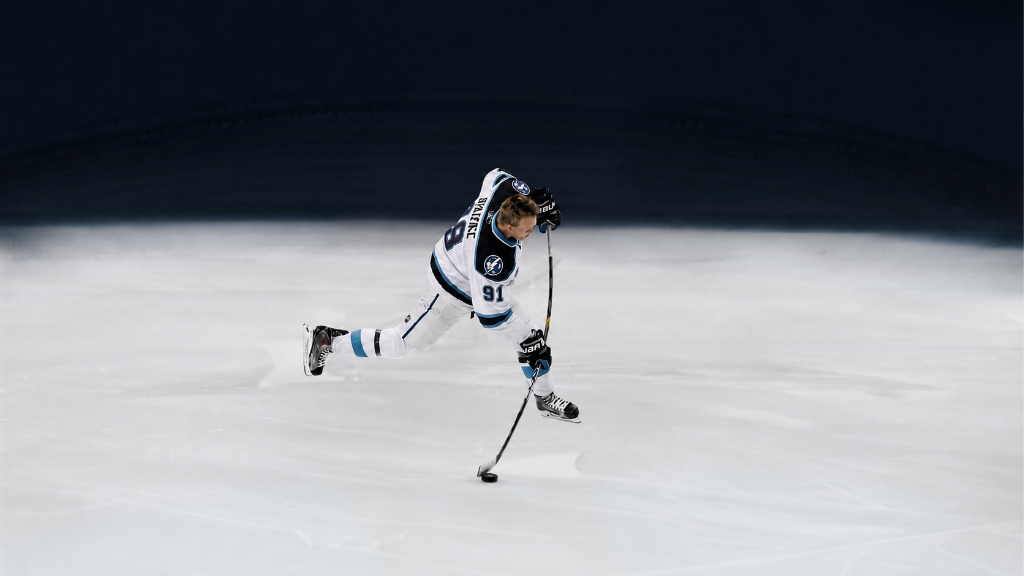
Choosing the right hockey stick flex improves shot release, accuracy, passing feel, and puck control. The wrong one can make even a high-end stick feel unresponsive or unpredictable.
The common mistake is assuming stronger players need the stiffest stick they can bend. The real goal is to find a shaft you can load consistently during actual game movements — not merely bend while leaning on it in a store.
Key takeaway: Use body weight for a starting range, height for factory length, and position to set the direction to test — then confirm on the ice. There is no universally perfect flex.
What Does Hockey Stick Flex Mean?
Flex measures a shaft's stiffness. A lower number, such as 40 or 65, bends more easily; a higher number, such as 87 or 100, requires more force.
When you press the blade into the ice during a shot, the shaft bends and stores elastic energy. As it straightens, some of that energy returns through the blade to the puck.
More flex, however, does not automatically mean more power. Research on elite players has found that more flexible shafts can store greater strain energy during a wrist shot's loading phase (The Sport Journal), but puck speed depends at least as much on how each player loads the stick as on the stick itself. Slap-shot studies show large player-to-player differences, so there is no universally perfect flex.
Start With Body Weight — but Don't Stop There
A widely used starting method is to pick a flex near 40–50% of the player's body weight in pounds. Bauer's fitting guidance recommends beginning slightly below half of body weight for players who need a shaft that's easier to load.
For example:
- A 100 lb player might start around 40–50 flex.
- A 150 lb player might start around 60–75 flex.
- A 200 lb player might start around 80–100 flex.
This is a testing range, not a final answer.
Starting Flex by Weight and Age
Age is the least reliable variable, because players of the same age can differ greatly in height, weight, strength, and shooting mechanics. The chart below is a practical starting point — synthesized from the weight method and current manufacturer options — not a formula.
Starting flex chart
| Approx. age | Player weight | Starting flex | Stick class |
|---|---|---|---|
| 4–7 | Under 50 lb | 10–20 | Youth |
| 6–9 | 50–70 lb | 20–30 | Youth / Junior |
| 8–12 | 70–90 lb | 30–40 | Junior |
| 10–14 | 90–110 lb | 35–50 | Junior |
| 11–15 | 110–140 lb | 45–60 | Junior / Intermediate |
| 13–17 | 140–170 lb | 55–75 | Intermediate / Senior |
| Older teen / adult | 170–200 lb | 65–90 | Senior |
| Adult | 200–230 lb | 75–100 | Senior |
| Adult | Over 230 lb | 85–110+ | Senior |
These ranges should never replace on-ice testing. Current Bauer lines commonly offer junior flexes around 30–50, intermediate around 55–65, and senior starting around 65–70; CCM's ranges follow a similar pattern, though exact options vary by model.
Height Determines Length — and Length Changes Flex
Height doesn't directly determine how much force you can generate. It determines the required stick length, which then changes how stiff the shaft feels.
While wearing skates, the top of the stick commonly falls between the chin and bottom lip; without skates, around the nose.
Cutting a shaft removes part of the lever and makes the stick feel stiffer. Manufacturers including CCM note that trimming the shaft raises the effective flex — often cited at roughly 5 flex per 5 cm cut — though the exact change varies with construction. Bauer prints cut/flex reference markings on many shafts to show the effect, though specifics vary by model line.
Shorter senior players, take note: Buying an 87-flex senior stick and cutting several inches off may produce something noticeably stiffer than its rating. A lower-flex intermediate with a shorter factory length may fit better.
Junior, Intermediate, or Senior?
The class printed on the stick reflects shaft length, dimensions, and available flex — not a strict age requirement.
Stick class reference
| Stick class | Typical modern flex | Approx. factory length |
|---|---|---|
| Youth | 10–30 | 45–48 in |
| Junior | 30–50 | 50–54 in |
| Intermediate | 55–65 | ~58 in |
| Senior | 65–110+ | 60 in or longer |
A taller or stronger junior may fit an intermediate; a shorter adult may prefer an intermediate rather than cutting down a senior shaft.
How Position Should Influence Flex
Position is a secondary adjustment, not the main selection method. The recommendations below are tendencies — drawn from common shooting patterns and manufacturer guidance — not rules.
Flex by playing style / position
| Playing style / position | Direction to test | Why |
|---|---|---|
| Quick-release winger | Lower end of range | Easier loading on snapshots and in-tight shots |
| Playmaking forward | Lower-to-middle | Responsive passing, handling, release |
| Two-way centre | Middle | Balance for faceoffs, passing, varied shots |
| Puck-moving defenseman | Lower-to-middle | Faster release through traffic |
| Slap-shot defenseman | Middle-to-upper | Resistance during aggressive loading |
| Beginner (any position) | Lower end | Easier to learn proper shaft loading |
CCM similarly notes that lower flexes are often associated with faster wrist-shot releases, while higher flexes suit players who rely on forceful slap shots. A defenseman who rarely slaps the puck may benefit more from a lower flex than a winger hammering one-timers.
Kick Point: Low, Mid, or Hybrid?
The kick point is where the shaft flexes most during a shot, and it shapes both release speed and power. Low-kick sticks load near the bottom hand and release fast — ideal for wrist shots, snapshots, and catch-and-release plays. Mid-kick sticks load higher up the shaft for maximum stored energy and shot power, favouring slap shots and one-timers at the cost of a slightly slower release.
Hybrid kick combines the quick release of a low-kick stick with some of the power and stability of a mid-kick design. Instead of flexing mainly in one fixed area, the shaft is engineered to load across a broader section — typically lower in the shaft while still using the middle portion for added energy. It's a versatile middle ground for players who want both a fast release and enough power for occasional slap shots.
The Best Method: Controlled On-Ice Testing
The most reliable approach is to compare two adjacent flexes in the same stick model, length, curve, and kick point. Take 15–20 wrist shots, snapshots, passes, and — when relevant — slap shots with each, and evaluate:
- How naturally the shaft loads
- Release speed without exaggerated effort
- Accuracy when shooting quickly
- Blade stability through contact
- Passing, puck-control feel, and performance late in a session as fatigue sets in
The right stick bends visibly during normal shooting mechanics without feeling delayed, unstable, or overly soft. A shaft that only loads when you dramatically lean into it is probably too stiff.
A 2022 pilot study by Léger and colleagues at McGill University (Léger et al., 2022, Sensors) showed that in-glove IMU sensors combined with machine learning could match players to their optimal flex, blade pattern, and kick point with 90–98% accuracy for slap shots and 93–97% for wrist shots — in under a second. The work is still experimental, but it points the same direction this guide does: the future of stick fitting is based on measured player movement, not age or body weight alone.
Final Recommendation
Use body weight to set a starting range, height to pick factory length, and position to set the direction to test — then confirm on the ice. For developing players, it's usually better to begin near the lower end; a stick that loads correctly teaches you how to use the shaft. The best flex isn't the stiffest stick you can handle — it's the one that delivers the most repeatable release, accuracy, and control in the situations that actually happen in a game.
Find your flex in seconds
Try our free Flex Finder calculator — weight, height, style, cut, and kick point, plus a stiff-vs-modern comparison.